Friday, May 16, 2014

Three Vintage Vixens at Lucketts Spring Market


Buckle up!


IT'S LUCKETTS SPRING MARKET BABY!
Saturday and Sunday, 10-5
Lucketts, Virginia 


 Come head to small town Virginia's rolling hills with us to find some treasures. 


There are three of us working together this year so we decided on a new name. Look for the Three Vintage Vixens booth near the rear entrance by the large parking lot (and lake, recently).


You know these ladies too. Sharon of Hand Picked Art is my longtime business partner with the Branches Barn Sales. Margaret is last year's vintage dealer and the idea lady behind Asher Hill Farm. Remember her amazing barn and bed shed? (click here to see a detailed look at her farm)


Well, the truck's all loaded and the rain storms have finally stopped. We spent the last few days doing a bunch of this:


Because of the rain, I don't have polished pics of the booth for you, like Miss Mustard Seed. But I do have a few little sneak peaks: 


Those are just the teensiest peek at what we have for you. There is a 20 x 10 foot tent packed (think "no breathing space") to the gills with great vintage finds. We're not quite sure where we're going to put it all. 

Several things have "Perfect Project Pricing", which is our way of saying "We know this has great lines, but it needs work." So we are pricing it to M-O-V-E! I think you'll be impressed.


And I have a give away!!! I have free samples of Webster's Chalk Paint Powder for the first 13 of you who come to the booth and mention the blog or CM Shaw Studios. As an extra bonus, we will be doing a drawing to give away a free large tin of Fiddes & Sons Clear Wax, also from the good folks at Webster's. (read more about how I came upon these goodies here). All you have to do is leave your email in a jar. My 6 year old will be blind-folded and pick the winner randomly.

So come join us! The rain is supposed to be on it's way out to sea, so think "Sunny and 70's" thoughts. And we'll see you there.


Lucketts Spring Market

THIS Sat. May 17 - Sun. May 18, 10-5

42350 Lucketts Road, Leesburg,VA 20176


Tuesday, May 13, 2014

How to make a pallet wood mirror...if you already have the back and some Webster's Chalk Paint Powder.

This project idea came about from some very disparate sources. In fact, this whole post came about through the odd juxtaposition of me having too much crap stuff with "potential" in my studio, (surprise, surprise), an unexpectedly generous donation, and me tripping over a piece of wood. 

Let's begin at the beginning, shall we? Julie Andrews thinks that's "a very good place to start." 

Jump back 2-3 years, when one of my friends was moving. I had been helping her clean walls and bathrooms, while she was prepping for several weekly garage sales to pare down the amount she would have to move. After the third or fourth garage sale, she started to get a little desperate. Knowing I was "crafty", she brought over some things that hadn't sold, but were pretty nice. In the pile were two kits to make smashed tile mirrors. Think wooden board with molding around the exterior edge, then an open place all the way around the mirror and molding framing the 8x10 in  mirror in the center all made out of raw pine. The idea was to smash the cobalt blue and white tiles and then thin set and grout them in some pleasing pattern around the outside of the mirror, circa 1997. All I saw was a woman who needed someone else to deal with all this stuff, so I took the mirror frames and a bunch of other stuff as an act of mercy. I'm sure I just shoved them somewhere out of the way in my studio and forgot about them.


This is an "in process" picture, as I forgot to take a "before" pic. 
But at least you all can see what I'm talking about now.

Let's fast forward to February of this year. A fellow designer friend and I get this great idea to do a nest and egg painting workshop where we will teach how to make chalk paint from latex and then use various glazing techniques to make the faux eggs look real. I love this idea and start shooting emails to all the chalk paint companies I can think of to get samples for my students to try. Of the eight companies I emailed, only one even bothered to respond. Webster's Chalk Paint Powder.


And respond they did. They sent free samples of their Chalk Paint Powder mix-in for each of the 14 potential student as well as a large tin of Fiddes & Sons wax to be shared among the class. Folks, this was an amazing corporate response for this little blogger. And it was so perfect for my workshop!


But I had to cancel the workshop, for reasons too numerous and annoying to discuss here.

In an effort to repay the good people at Websters for their generosity, I started wondering what amazing project I could do to post about their product. I thought of redoing vintage frames, or boxes, but that just didn't seem sexy enough. And I didn't have room for another piece of furniture. 

One day,  I was mad at my kids for something, so I went into the studio and started whacking away at a pallet I was trying to break down. If you are mad at your kids, I highly recommend this way of releasing negative energy. It is so satisfying to beat the crap out of the wood rather than the child. After removing several boards by brute force and discarding them randomly, I took a step back. 

You know that moment in a James Bond movie, when the villain accidentally steps just a hair too far off the edge of a cliff and you see the whole weight of his body shifting towards the abyss? And you know at that second he is going to go careening off the edge to his doom? 

Yeah, that's what my foot and body did as I tripped over one of my hastily discarded boards and came crashing to the floor. It was so gloriously out of control and completely awkward, that I just burst out laughing. While I was cracking up, my eyes fell on the box Webster's had sent me. My mind put two and two together and I thought, "I could use the Chalk Paint Powder with all this latex I have laying around and all this pallet wood and make super cool mirrors to sell at Lucketts!"


So that, friends, brings us to our project today.


How to make a pallet wood 
surround for a mirror:


1. Have a desperate, moving neighbor dump a bunch of craft supplies in your lap. 

2. If this isn't likely to happen and you still want to make a mirror like this, go buy yourself a sheet of Masonite or thin (apx 1/4 in) MDF at Lowes or Home Depot and have it cut to the size you want the whole piece to be when you are finished.

3. Choose whether you want to use an existing, pre-framed mirror (you could get one really cheaply at a thrift shop or a garage sale, or there's always clearance at Target or Home Goods). The simpler the frame the better this will look, and the easier it will be to match the molding. If you decide to build from scratch, it would be easiest to purchase a pre-cut mirror at a craft store. Get whatever size you want. You could also use a larger size picture frame for the outer frame and have the backer wood cut to fit that.

4. Get a length of small, simple molding, as this will let the pallet wood be the star of the show. Decide whether you are going to use butt joints or mitred joints. Butt joints are easier and stronger, but mitred joints look better. If you are making everything from scratch and using a craft mirror, figure out the lengths you need for both the interior and exterior frames, based on the joints you are going to use, the backer board you already had cut, and the size of your mirror. I would use Loctite Wood construction adhesive and some clamps and just glue everything together. I love that stuff. 

I would lay everything out, including your mirror, before you start gluing. Get it where you want it, and then trace the outside of the mirror with pencil. Glue this down first. Then glue the mirror molding down. Then the outside frame.

If you are using a pre-framed mirror, do your best to match the molding your mirror came with, but don't stress about finding an exact match. Once you paint them the same color, a lot of the differences will disappear. All you need to build is the outside frame for the whole board. Once your frame is cut, line it up, but don't glue it down. Lay out your pre-framed mirror in the center and make sure the whole thing looks like you want it to. Trace the outside of the mirror onto your backer board with a pencil. Then glue the mirror down first, applying the glue to the mirror back and using the pencil outline to guide your placement. Once the mirror is in place, then glue the outside frame together, suing the edge of the backer board as your guide line.

Once you have the frames all measured, cut, placed checked, and frames and mirrors adhered to the backer board, you can start doing funner stuff like painting and cutting pallet wood.

5. Figure out which pieces of pallet wood you want to use and how you want them stacked around the mirror. I get weird about things like how nails line up and having the same grain patterns together, so this is an important step for me. If you're more laid back than that, then pick your boards and go on to then next step. If you have no idea what to do with a pallet, read this post first.

6. Figure out how your boards are going to fit around your mirror. Do you want them to run horizontally or vertically? I did horizontal, because I felt it showed the most of the varieties of pallet wood I was using. (ie. most of the pieces just seemed bigger that way.) I would recommend trying to avoid notching around the inner frame unless you really know your way around a table saw and jig saw. Just try to choose a stack of board that are the same height as the mirror frame. You will be able to cut the top and bottom boards width-wise to fit what's left.

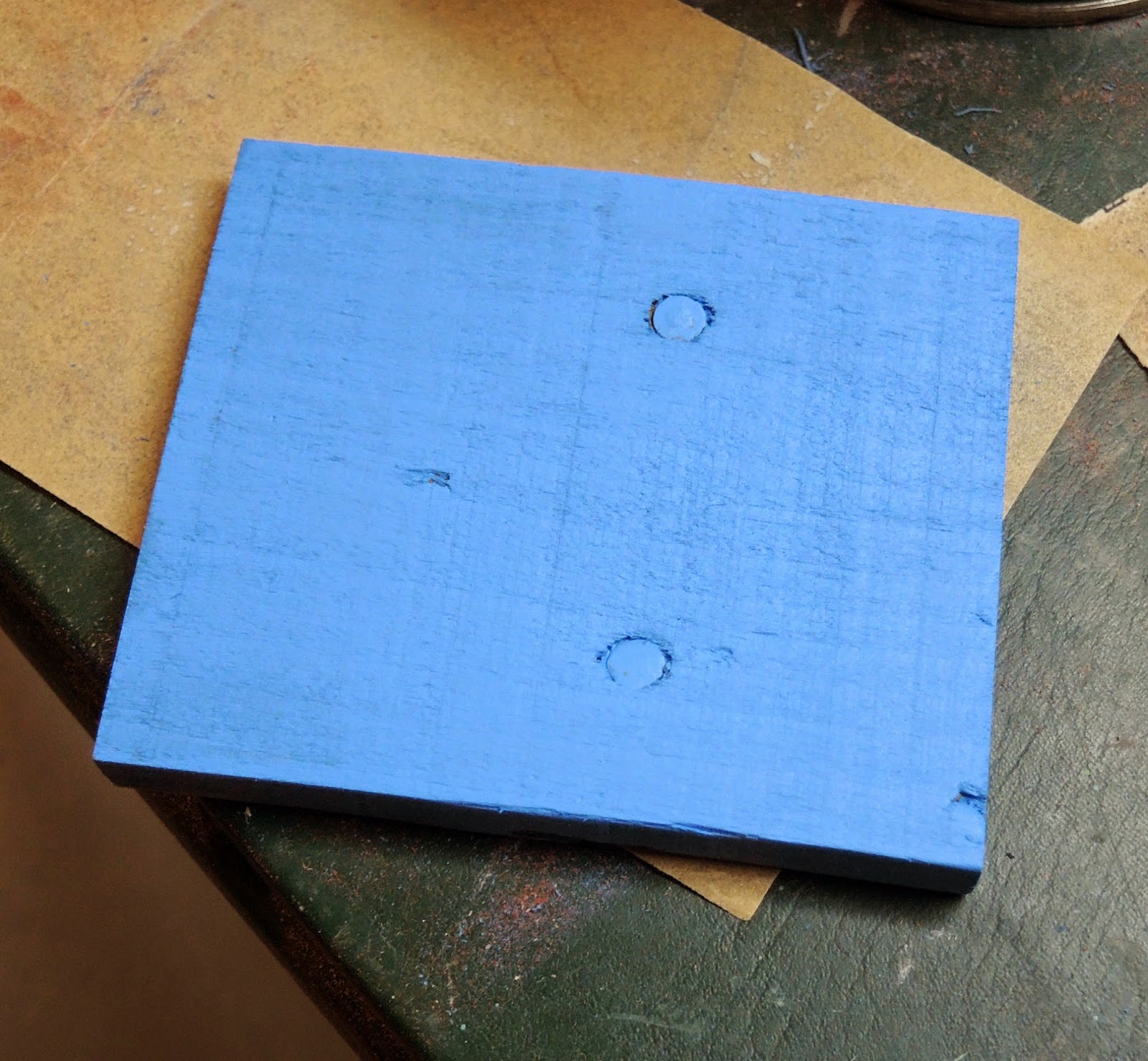
See how the white board just rests right on the inner frame and the blue wood comes right up to the edge? This is the easiest way to do it. The brown board was cut thinner to accommodate everything else lining up.

7. Start measuring the boards that go next to the mirror first. I measured from the inside of the outside frame to the outside edge of the inner frame. Mark the wood carefully. Then use a mitre saw or table saw to cut your pallet wood to size. Please be very careful to avoid nails!!! Swap your wood around or turn it another way, or just remove the nail if it is in your cutting path. It could ruin your saw or kick something up in your face while cutting. The "character" of having that one nail is not worth losing an eye or replacing a power tool, I promise.


I repeated this process for all the smaller pieces of wood, placing them in the frame as I cut to be sure they fit nicely. If the were just a hair too wide, I sanded them with a 100 grit sandpaper until they fit like I wanted.

8. Once all the smaller "side" pieces are cut, get out your end pieces and cut them to length. You will adjust the width once they can fit in the frame. Measure from the inside of the outer-most frame to the other inside edge of the same frame. Remember, we are not working with the mirror frame right now. Cut your wood to fit. Repeat for all pieces that will be above or below the mirror.

I know this mirror has notched pieces and I told you not to do that (I got help from a woodworker friend) , but it also shows you how the green piece was cut thinner to accommodate the orange piece's width.

9. Once you have all the wood cut to length, figure out how much you need to take off the width. put all the pieces, short and long, in the frame where they go. Slide in all the wood that will be full width. Whatever space is left over is the width you need to cut your wood to. The easiest way to do this is with a table saw. Use a stationary guide rail and a piece of scrap wood (rather than your finger) to push your piece past the blade. Check for size and sand or re-cut if needed.
Repeat for all remaining pieces until mirror surround is full.

10. Sand all wood until smooth enough to handle. Pallet wood loves to give you splinters. I used 150 grit and then 220 grit to make it silky.

11. Now you get to paint! Woo Hoo! 


Choose your colors for the frames and the boards. If you are using regular chalk paint, like ASCP or Fat Paint, etc, then paint, wax and distress away. I didn't prime anything first. I did, however decide to try something new.

This is where the Webster's Chalk Paint Powder comes in.


I had a bunch of sample size latex "oops" paint that a friend had given me, as well as some really great wall colors left over from various projects in my home. I thought this was the perfect time to give "The Powder" a try. 

I used all different brands of latex from Valspar to Behr to Benjamin Moore Aura to Sherwin Williams between all the wood on the two mirrors. I also used Annie Sloan Chalk Paint, because I liked the colors and I had it on hand. The samples were nice because they are roughly a cup. (I didn't measure and the people at Webster's may be cringing right now. If so, sorry guys!) If it makes any difference to anyone, it worked just fine.

I am super anal about how my colors relate to each other, so I take each of the paint cans or jars and place it over the board I am going to use it on, to be sure I like how they all relate to each other. Often I think I'll love one color, only to hate it next to another one. I tweak and replace and readjust until I'm happy, then I paint the wood. But that's me. If you're lower key, just have at it.

12. Mix your latex and chalk paint powder. 


 This is super easy. You take 2 Tbsp Chalk Paint Powder and dump them in a container. Then you pour in 1 Tbsp tap water and mix them until the powder dissolves. This is a terrible picture, but it looks like this when it's ready:


Then you just pour the water/powder solution into the pre-measured paint and mix away.


When it's all mixed, you use it the same you would use and boutique brand of chalk paint. You can distress or wax or glaze or whatever your little heart desires. And it keeps for a while. I started fiddling with it about 2-3 months ago and my air tight sealed samples are still fine.

I applied one coat of each color to my pallet wood boards. 


See? The Webster's paint covers just like chalk paint. This is one coat.

I used a little different treatment to my bases, depending on whether it was the dark set or the white one. The dark set I stained the pine first. Then I painted over the stain and the whole background with blackboard paint. My plan was to rub off some of the paint with a wet rag, so the stain could show through without being sanded off. Apparently blackboard paint is harder than chalk paint. Very little came off with the wet rag. So I distressed the tar out of it with 100 grit sand paper, and sanded off all my stain, but exposed the right amount of wood. Undaunted, I just stained it again over the paint. Then dark waxed the whole thing. Whew.


This is a terrible picture again, but it give you an idea of the technique used on the darker frame. And staining over sanded paint works great!

For the white mirror backer, I used one coat of ASCP for the base and then distressed it to just reveal the wood underneath. 


14. Once you have painted everything and let it dry, it's time to distress. I usually use 150 grit and then 220 grit for this process.  I did find that the cheaper paints like Glidden mixed with the Chalk Paint Powder were a bit harder to distress than ASCP is. But I just switched to a lower grit paper and it worked fine. Keep in mind, I did not measure how much paint to powder I was using, I eyeballed it. This may make a huge difference. If it matters to you, measure to be sure you have the right proportions.


15. Once everything is distressed to your liking, wax it. I used only a single coat of matte clear wax on the white mirror pieces.( I used a matte wax on the white set called Renaissance, because I wanted them sealed, but not shiny. It's pricey though. I already had it for re-waxing my antique armoire. But you could use any wax and be fine.) The dark mirror pieces got Annie Sloan clear wax, then dark wax, then clear wax.

I was also careful NOT to wax the back. I have no idea how construction adhesive would do with wax and didn't want to find out.

16. Let the wax dry. Then glue everything together. I let the waxed pieces sit overnight, mostly because my kids had come home from school and my project time was over for the day. When I came back to it, I made sure I loved how everything looked and then started gluing. I used a board turned vertically to hold all the side pieces in place with one clamp and one clamp on each end of the top and bottom boards, because I didn't want any warping and the board already had a hint of a buckle to it. If you don't have clamps, anything heavy, left overnight would help the glue set nicely. I left the clamps on overnight.

17. Take the clamps off and add D-ring hangers and a wire so you can hang your new mirror. Drill pilot holes a little smaller than your D-ring screws into the back of the mirror, being sure BEFORE YOU START DRILLING that your screws are short enough not to come through the front of the mirror. Once you have your pilot holes, you can place your D-ring and then screw in the screw. Repeat on the other side, being sure that the two rings are level and the same distance from the top of your mirror. Add a wire between them if you wish. 


And you're done!

Can you tell which of these boards I used Webster's with and which ones are ASCP? 
Neither can anyone else. And it's way cheaper.


I can't decide if I like it better this way, or with the blue on the top. 
Turn your head upside down and tell me what you think.

These mirrors will both be available at the Luckett's Spring Market this weekend. 
Come check it out Saturday and Sunday 10-5 in Luckett's, VA. 
I promise it's worth the drive and the entry fee. 
Plus I'll be giving away free samples of Webster's Chalk Paint Powder for you to try.

Talk to you soon,
CM Shaw

PS: I was not paid for this post in any way. Webster's Chalk Paint Powder company sent me the free samples for my class and one for myself, but did not ask for a post or provide any other incentive. I just liked that they acknowledged me and and I found their product insanely useful. All opinions are completely my own. 

Does that sound like the Queen of Hearts in Disney's Alice in Wonderland?
 "All ways are My ways!"


Monday, April 28, 2014

Empty

I feel empty and sad sometimes. Mostly at times when my "Mommy" life has taken over and my "Artist" life hasn't seen the light of day for far too long. While I appreciate the value of being a mom and raising well adjusted little people into big, well adjusted people, it isn't enough for my soul to just do that. Sometimes I wish it were, and I actually know quite a few people who gain a huge amount of fulfillment through caring for their kids and managing their homes well. And I am so happy for them. If you are like that, consider it a huge gift. I am not like that. While I love to see my kids flourish, doing the day to day management gives nothing back to me. I gain little joy from my house being cleaner, other than the satisfaction that I won't look like a total loser if someone comes over. But I think peer pressure and joy are just a teensy bit different.

So what is my point here? My point is that sometimes the crappy stuff takes over. And you just have to keep dealing with it. I had to postpone my workshop at the beginning of the month and then give up all creative pursuits for the entire month. It's just how the cards fell. So I have been reminding myself that life is not "being mean to me", it's just the way things are right now. I keep trying to remind myself to look and actually see at the beautiful weather (finally) and all the flowers. I have been trying to remember to find the nuggets of beauty tucked into each moment. 

All during spring break I watched my oldest daughter laugh freely and run in the sand with an unfettered joy I haven't seen for a year. I watched my eleven year old be the belle of the ball, surrounded by happy friends at her self planned and very successful birthday party. I have watched my youngest play dress up with her best friend and fall in love with her American Girl all over again. 

And we got a dog. She is a 4-5 year old beagle/hound mix from the pound. And she is a delight most of the time. I have been relearning why I liked animals so much when I was a kid. It has been 20 years since I lived with a dog, and I had forgotten how funny and sweet they can be.

But all this beauty still hasn't been enough.

I keep finding myself in tears in the corners of my house. My heart keeps returning to numbness. I don't want to write in my journal in the morning because there is nothing creative going on inside me, only enduring. And while I am all for enduring, I'd rather live my life than just grit it out.

So I started praying. And I felt better for a little while, but the sadness returned. So I worked some more and served some more and exercised some more. And they all worked until I stopped moving. Then I would just start crying again. And the doubts would hit that no one, not even God valued me being an artist or a blogger. That this period I have been going through for the last 3 years would never end. That something else would ALWAYS be more important than my dreams for myself and that all I would ever end up being would be an over weight mother with an eternally dirty house. 

I think this is the point when I threw myself on the floor and started crying hysterically. You're glad you weren't there. And so is DK. It wasn't pretty, and fairly reminiscent of a 4 year old's tantrum. At some point, I realized that this was not helping me and that the carpet needed to be shampooed sooner than later, so I got up and headed for the shower.

I don't know if I've ever told you guys this, but I have the Shower of Magical Knowledge. Seriously. It is the place where God talks the clearest to me. I know that sounds crazy, but you guys already know that about me, so I figure I might as well tell things as they are. 

So I get in the shower. And I start crying again, as I keep thinking how angry I am at God. Then I start screaming, I mean really screaming at the top of my lungs in my magical shower asking God why he made me creative, if I was never going to be able to use that gift? Why did He tell me to blog if I was never going to have time to post? Why did it feel so oppressive when I don't have any "real" problems? I screamed so loud, my throat started to hurt. And I have to be honest ladies, it actually made me feel better to scream at God, not because I wanted to accuse Him really, but mostly because it got all that pent up anger out. Once I had expressed all my venom, I apologized for my outburst and  finally got to asking the most important question, "Lord, what am I supposed to be learning from all this?" That, my dear friends, is when I got an answer that I could hear.

Sometimes the answer to our dilemma is to paste on a plastic smile, pray for the strength we need, and just wade through the challenge. Sometimes that doesn't work. And that's what happened here. I wish I could always remember the incredible kindness of God, but sometimes I can't and I get wrapped up in my fears and layer on my negative echoes of the past. I blame God for not "blessing" me even when I'm doing everything thing He asks. It is only AFTER I express all my pent up fear and misery and anger to Him that I can come back to my senses and feel the peace He gives. 

This, friends, is how you give your sorrows to the Lord. You talk to Him directly about them. Don't worry. He can take it. And then, if you need to, you apologize. He will take your fear and shame and anger and worry from you. And then, when you are ready, He will teach you what you need to continue on in joy...for a while. Keep in mind, this is a process.

My answer this time was that I am in a period of learning, rather than producing. I need to look at what others are doing. I need to think about art, I need to understand more about art. I was told this same thing several months ago, and I had been doing very well with it and was very happy, but then I forgot and got lost. With that simple reminder, things in my life lined up and fit into place again. I am ready to keep going forward with enthusiasm. As a special bonus, (maybe I really AM being as good as I told Him I was) He showed me what a profound impact the service I had been providing at the expense of my art time had made on my children and others I had given it to. Nothing quite like being shown just how "worth it" your sacrifice was. 

At the moment, my heart is full of gratitude,

  •  for a God that loves me enough to take a yelling at and still re-balance me because He knows it will help me become my best self, 
  • for the bounty I have of beloved people and lovely possessions, 
  • for the fact that even when I was suffering, I was smart enough to notice the joy and beauty around me. 
  • And for this blog, where hopefully you all will benefit somehow from my foolish ramblings and poor, (or sometimes good) choices.

You guys ever yell at God in the shower? I'd love to hear your experiences.

Talk to you soon,
CM Shaw

Monday, April 7, 2014

The 8th Grader Saves the Bay...In Luray?

I come from a long line of Conservationists. My grandfather was always trying to teach us the names of plants and trees around us and taught us how to work the land with respect. He was incredibly well versed in the Native American culture and taught us to be at one with our environment, to make decisions that would care for the world around us and preserve it's beauty for the people to come after us. My dad took pruning sheers to the Lake to trim the beach shrubbery and get it healthy again. He would have us pick up trash were ever we went and pounded the mantra of "leave no trace" into us with regard to any natural location. I am personally a big fan of public recycling and composting. I even recycle my computers and I am the reason there is never any space in the grocery store containers for your plastic bags. I am borderline fanatical about recycling plastic bags. 

But I had no idea just how much all of this had filtered down to my children. 

Last year, my then 7th grader took Environmental Science in school. They had several water quality experiments and a great field trip involving wearing hip waders to take water samples out of the middle of a stream. I highly recommend chaperoning a field trip where you get to watch a bunch of 7th graders flopping around in a river wearing hip waders. Very entertaining. My daughter was so captivated by this experience, that she chose to do her research project on water quality and tested the quality of the water in the stream behind our house and helped clean up a few other streams in our area. 


Fast forward a year. The same child gets assigned 5 hours of service to be performed for the cause of her choice. For some reason, I was surprised when she chose the Save the Chesapeake Bay Foundation. Sometimes we moms can be a little thick headed.  I was thinking of feeding the homeless or something a little more people oriented. But she was underwhelmed by this. Water quality had become a bit of a personal mission for her. So I told her to go ahead and figure out how to Save the Bay.

About 2 days later she comes in "Mom! Mom! Can we go build a riparian border on the banks of a river this Saturday? It's almost the end of the semester and this is the only activity they have before the service hours are due!" Um...riparian boarder?...what? Because I didn't have anything else going on during soccer season the first weekend of April, right? (And yes, this little shenanigan was part of the reason I ended up postponing my workshop.)

But then I stopped for a second. And thought about all the times I had encouraged her to "find her bliss." Here was my 8th grade daughter doing all the work, sending out all the registration emails, finding an event that she was really interested in to help a cause that she was completely committed to... I figured I could at least look at the info on the promotional page. 

The event was a great time, not an easy date, but do-able if I made some arrangements, and then I looked at the location, Luray, VA. That's about a 1hr and 45 min drive. And the event started at 8:30am. So I would be leaving at 6:30 am on a Saturday morning to drive to a farm to plant trees and shrubs on a stream bed for 5 hours to then drive the almost 2 hours home. I looked up at her, her young eyes glowing and full of enthusiasm and hope. 

I almost said, "No", but then remembered a book I'd read about 5 years ago called Planting Noah's Garden. I had become completely enamored with the idea of making a naturalized garden, but had never had the opportunity to do it. Particularly the chapter on restoring a stream bank. And here was my big chance! 

So I told her to get us all registered. She squealed in the way only 8th grade girls can and ran off to the computer. And I found myself with a little ember of excitement in my own heart. 

Saturday proved to be a glorious day. The weather was clear and cool and we woke early and sped off towards our pending adventure with great anticipation. There is just something magical about going on a road trip. The novelty of it. The sense of adventure. The views as the world goes speeding by. It is just the best.

We made it there in good time. And we didn't even get lost due to good email directions by Robert Jennings, the director of this event and my daughter's newly acquired map reading skills. 

We turned at an event sign in the road, followed a gravel road between to berms 
and pulled up to see this:


Pretty bleak.

It was pretty much devoid of any kind of vegetation. The area around the stream had been used as a feed lot for 200 head of cattle for years and years. Anything green or alive had been eaten or trampled a long time ago. By the time we got there the only thing living on that ground were the starts of native grasses reintroduced by the White House Farm Foundation that had bought the farm in 2012 with the intention of restoring it and using it as a model of sustainable agriculture and ecological practices. 

Here it is in color. And I promise I didn't shoot it in B&W just for dramatic effect, although it is pretty dramatic. I actually couldn't see the photos on my screen because of the angle of the sun and didn't realize I was still in the "Copy" setting until after I took these. 

Here you go, in Technicolor.


You can totally see the potential of the place. The site is so nicely laid out with the berms and the curve of the stream. It could be rather picturesque. But you can also see how lacking it is in vegetation. When the WHFF people bought the property, there was nothing but dirt and exposed bedrock. Everything else had been stripped or eroded. My "before" pictures are after two years' worth of regrading the hills, adding back all the lost topsoil, reseeding the grasses and adding jute netting to prevent all that work from eroding in the rain, wind and snow, and then clearing back any weeds that had sprouted up along the stream banks. Whew! It makes me tired just thinking about it.

Fortunately, they saved all the quick fun, rewarding stuff for us volunteers. We got to plant trees. 


After telling us the nature of the agencies involved (Save the Bay, White House Farm Foundation, and a conservation oriented branch of the USDA) and how all the trees we were planting would effect the water quality and ecosystem of the 2 acre stretch of stream we were repairing, we learned the right way to plant a baby tree. (Robert, if you're reading this, please remind my what this long suffering man's name is and who he represents? I'd love to give everyone credit, but it was pretty early when you all were talking)


Step one: See how deep your hole needs to be. You figure this out by looking at the roots of the sapling. the place where the roots stop and the bark changes and flares a little is the perfect depth.

See that spot where the roots stop growing out and there's a bump and then the bark gets smoother? That's what you are looking for.


Step 2: Dig your hole. You want to go a bit wider than the tree so you can loosen the soil around the baby tree to make it a bit easier for it to spread out its roots. the organizers had made siting easy for us by previously spray painting orange dots on the ground to mark where the trees should go. 


Step 3: Remove competing vegetation, to give the tree it's best chance at getting water and nutrients. You undercut the grass about an inch and a half to get rid off the roots, then you remove some of the dirt and just flip over the grass chunks, grass side down to replace and keep the ground level around the tree.


Step 4: Place tree in the hole and cover with dirt. it works better if you break up the dirt clods with your hands and make sure that the dirt is packed, but not compacted when you are done. And be sure to keep your tree roots below the ground and the transition line of smoother bark right at the ground level, not too deep, not to shallow.


Step 5: Add protective tubing. This plastic-y tubing protects the tree from being eaten by animals like deer, and also acts as mini greenhouse. You just carefully slide it around the little tree and then push it into the ground. Be sure to put the flared side up and the stake ties facing down stream. If you twist and push about half way down the tube, it goes in the ground "like butta". Well at least it did for us, but it had been raining for a week before the project so the ground was nice and soft.


Step 6: Add a wooden stake to stabilize everything. This is where a sledge hammer or rubber mallet come in handy. You run the wooden stake through the open nylon ties and then hammer it into the ground until it's about 1-2 in higher than the top tie. It is sometimes helpful to hold the tubing away from the stake so you don't smash the tubing. It can take some pretty good whacks to get the stake down as far as you want it to go, even if the ground is soft.


Step 7: Cover the surrounding area with landscape fabric to help keep down the weeds. This ensures the fledgling tree the best shot at all the water and nutrients the ground has to offer. The black fabric shade the ground, helping to prevent weeds that might grow faster than the tree or take away water or minerals away from it. These guys think of everything!


The landscape fabric was cut into 3-4 ft squares with a slit right in the center. Making sure the fabric was shiny side up, you slid the slit over the tube and stake and then pinned the corners down. You rolled the fabric over 2 times to ensure that the staple wouldn't rip through and then pinned the corner with a u-shaped staple that was about 6-8 inches long. Most of the time you could just push them right through the fabric and into the ground, but if there were rocks or the ground was a bit harder, you could step on them or hammer them down.


Step 8:Stand back and admire your tree. If you finish all these steps, you should be pretty proud of yourself. You have just made a major investment in the future. Be ready to do some daily watering, if this is in your yard.

After our little demo, they put us in pairs, handed each team a shovel and a sledge hammer and put us to work. One person dug the hole while the other got the tree and the supplies. They varied the variety of tree you planted so the whole grove will grow up to be completely diversified. 

Shall we see how the 8th grader did planting some trees?

 Orange marks the spot. 
Nice hole depth. Pretty good technique with the grass removal. Not too shabby.
And here is the tree, all nice and tucked into its new little bed.
Action photo as the 8th grader starts laughing because she almost hits herself in the face with the sledge hammer. Easy girl.
 Ooo...Photo Op with Robert Jennings, the director of this project. That sure was a man who loved his job. Always a happy thing.
And now the rolling of the landscape fabric. Where did you put those staples, Mom?

Oh how I love Nancy the Northern Red Oak! Grow big and strong little tree!


The girl and I planted 14 trees and 25 shrubs in the 5 hours we worked. There were about 20 volunteers there, so do the math on that one. I was astonished at how much our little group got done.


Remember where we started? 


Crazy, right?

Here's a few more "afters":


These may not look like much to you, but I see a gorgeous grove of trees in 10 years, shading the water, cleaning the soil, and possibly making this a home for trout and other fish and wild life. I can smell the green when I look at these photos. It just feels like pure optimism to me.

In any case, it was one of my favorite days in a long time. Every so often we'd look at our watches and being amazed how much time had gone by without us knowing it. I just got lost in the work and ground and the air. I felt part of something bigger. And the 8th grader just grinned and grinned. If it makes my daughter happy all the way to her liver like that, I am all for Saving the Planet. One tree at a time.

I'd love to hear about your conservation or service adventures. Leave me a comment.


For more information about the Chesapeake Bay Foundation, click here.
For a list of volunteering opportunities in VA/MD click here

To learn about the history of and mission of the White House Farm Foundation, click here.


Talk to you soon,
CM Shaw